
Category

Resources for Seniors

What do I do when the Doctor says it’s Alzheimer’s?

By Resources for Seniors

What Do I Do When the Doctor Says it’s Alzheimer’s?


I refer to Alzheimer’s as being like a light switch that goes on and off in the brain. From the moment you know the diagnosis – that is the time to start planning.  You never know when the switch will flip.  The time to take control is immediate because you don’t want to make decisions in crisis mode. It is much easier to plan when you have the opportunity to gather information rather than having a few options during a time of crisis.

Planning is  Key

Talk to your loved one and all the family members that want to be involved with planning. It is never too early to start planning. Some areas to think about include financial planning, health care planning, legal planning, directives, and safety in the house. Refer to the Checklist to Organize Family, Legal and Care Matters which I have created to help you start the conversation and gather the documents you will need. It is important to note that there are specialized Elder Law attorneys, insurance and financial planners that can give you expert and current information and will help in your planning to make sure you have things in proper order.

Be a Successful Caregiver

Alzheimer’s is a tricky disease. It can give you the sense that all is okay and then the light switch flips and you are switching to crisis mode. There will be many light switch moments as you work through the Alzheimer’s diagnosis. There are many people available to help you through each of the various situations.  In my book, Simply Caring: Putting the Alzheimer’s Puzzle Together, I have gathered many resources for you to use.  Reach out to the local chapter of the Alzheimer’s Association. Reach out to me.  Caregiving is stressful and you don’t have to go it alone.  I want you to have the tools, training, education and information to be a successful caregiver. I am here to help you, your loved one, and your family.


Highlights from Author and Almost Home CEO Jamie Glavich, Simply Caring: Putting the Alzheimer’s Puzzle Together. View more at SimplyCaringBook.com.

From Mood to Memory: How Food Can Enhance Brain Health

By Resources for Seniors

From Mood To Memory:  How Food Can Enhance Brain Health

A healthy brain depends on genes, the environment, and lifestyle. We can’t change our genes, and may not be able to alter our environment, but we definitely have control over our lifestyle! Lifestyle consists of diet, stress management, and activity. While each one is critical for maintaining brain health, below details how dietary choices can improve brain health and function.

As the control center of the body, it consists of billions of neurons that send signals through the brain. These signals allow for memory formation, thoughts, and feelings.  Our brain makes up 2% of our body weight but requires 20% of our resources. It’s mostly made up of fat and therefore dietary fat in the form of “Omegas” contribute to a healthy brain. Protein provides the necessary amino acids that allow for brain signaling and carbohydrates break down into glucose that provides steady, sustained brain power.

There are many nutrients that keep the brain running smoothly. Here are some general nutrition guidelines on what to focus on when considering improving brain health.

Heart Health is Brain Health

The brain needs constant and adequate blood flow, which provides the supply of oxygen to keep it functioning properly. This means that a healthy heart and vascular system is necessary to maintain a healthy brain! To maintain a smooth vascular system, one without atherosclerosis (hardening of the arteries), the focus is on fiber and antioxidants. So this means a lot of fruits, especially berries, and a balanced amount of beans, whole grains, and vegetables.

A Happy Gut is a Healthy Brain

Did you know most of the neurotransmitters that contribute to “feeling good” are created in the gut? Balancing the trillions of bacteria, both health promoting and opportunistic, in the gut can greatly improve our mood. Adding in Omega-3 fatty acids (almonds, walnuts, chia seeds, ground flax seeds), iron-rich foods (spinach, legumes, oats, nuts), and even spices such as cinnamon, nutmeg, cloves and oregano can support a healthy, happy mood.

“B” the Change

B vitamins such as folate, B6 and B12 are critical for improving memory, mood, and maintaining a sharp mind. B vitamins are found in whole grains, mushrooms, broccoli, brussels sprouts, beans and potatoes. You can also find a healthy amount of folate in leafy greens (think foliage) and B12 can easily be obtained by supplementation.

A healthy lifestyle is not about restrictions, it’s about creating new habits. The combination of dietary interventions with added activity, intellectual and social stimulation, and quality sleep can make a profound improvement on one’s life. For more information regarding nutrition and brain health, please feel free to contact Registered Dietician, Heather Borders, with Kailo Nutrition at (904)250-0910 or heather@kailonutrition.com.


Simply Caring: Putting the Alzheimer's Puzzle Together

Introducing The Simply Caring Book

By Jacksonville, Resources for Caregivers, Resources for Seniors

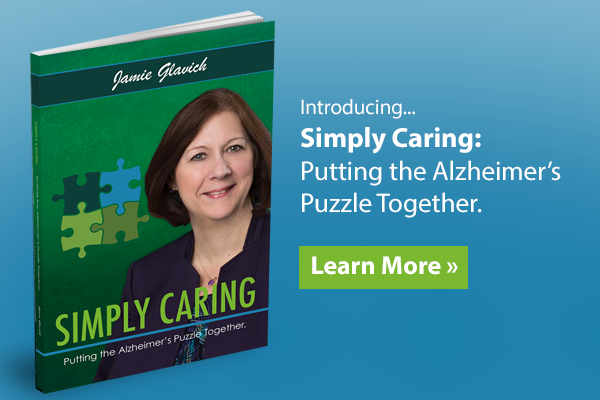
Introducing Simply Caring: Putting the Alzheimer’s Puzzle Together written by Jamie Glavich.

Visit SimplyCaringBook.com

Founder of Almost Home, Jamie Glavich is on a mission to provide guidance, inspiration and resources to families dealing with the challenges of Alzheimer’s and dementia.

In her book Simply Caring, she discusses key points about the disease, what to expect and how to prepare. She answers important questions and provides resources to make sense and put the puzzle together of Alzheimer’s.

Questions answered include:

  • What should be the foundation of care?
  • What is Alzheimer’s Disease?
  • What do I do when the Doctor says it’s Alzheimer’s?
  • What are my options in care?
  • What specific caregiving matters do I need to know?
  • How do I start the day?
  • How do I get through the day and what is Sundowning?
  • The day is almost over, what next?
  • How do I communicate and visit with my loved one?
  • How do I put the pieces of the Alzheimer’s puzzle together?

To learn more about Simply Caring and download a free chapter of the book, visit SimplyCaringBook.com.

Almost Home Holidays

Holistic and Therapeutic Caring for Seniors in Jacksonville, FL

By Adult Daycare, Assisted Living, Jacksonville, Resources for Seniors

Almost Home DayBreak employs a holistic and therapeutic approach to caring for your loved one. The daily program provides for the physical, social, cognitive and emotional well-being of each participant. Our goal is to, at minimum, help your loved one maintain their current level of skills. At best, there may be some improvement in areas thanks to the structure and nature of the program. Activities target the whole person and individualize where necessary and possible.

Art Therapy is one activity that is a creative outlet for people in whatever stage they are currently experiencing. Parts of the brain that deal with colors and composition can still be used and developed by those with Alzheimer’s. It is amazing that people are able to continue to create art. Working with art can be calming to someone with Alzheimer’s. It may help create a period of sustained concentration that will improve their mood for the day. We feel anyone can be an artist – after all art is in the eye of the beholder!

Adult Day Care Jacksonville

101 Things to Do With a Person Who Has Alzheimer’s Disease

By Resources for Caregivers, Resources for Seniors

Daily activities for people living with Alzheimer’s disease tend to change as the disease progresses. Alzheimer’s tends to limit concentration and cause difficulties in following directions. These factors can turn simple activities into daily challenges. Individuals with Alzheimer’s often don’t start or plan activities on their own. When they do, they may have trouble organizing and carrying out the activity. Many caregivers state that the individual often sits in one area of the room, paces the floor, or searches for familiar objects with little interest in doing the things that had once brought meaning and pleasure to life.

By using a variety of activities matched to the person’s abilities, the caregiver can help the family member enjoy his current level of skill and talent, as well as retain his sense of positive self-esteem.

Below is a link with a PDF that contains 101 ideas to help pass the time throughout the year.

Click Here to Download Your Guide »

101 Things to Do with a Person Who Has Alzeheimer's Disease
Call Now